

Beyond Coverage: The Operating System Behind Medicaid Reentry
Medicaid reentry is usually explained as a coverage change: people leaving jail or prison can now have Medicaid active before they walk out the door, instead of starting from zero weeks or months later. That description is accurate. It is also the least demanding part of the work.
In practice, coverage is the policy. The workflow is the system. And the workflow depends on whether a set of organizations that have never shared a process can now reliably do seven things for the same person, in order: identify who is being released, anticipate when, confirm Medicaid status, assign someone to own the care, schedule services that land after release, keep medications from lapsing in the gap, and document the handoff so the next system can pick it up. Miss any one of those and the coverage exists on paper while the person falls through in real life.
Here's the thing about paper: it only wins if there's a rock to beat. Policy is the same. It only prevails when the infrastructure is already partway built underneath it. Take the rock away and the paper isn't winning anything. It's just sitting there, waiting for the scissors.
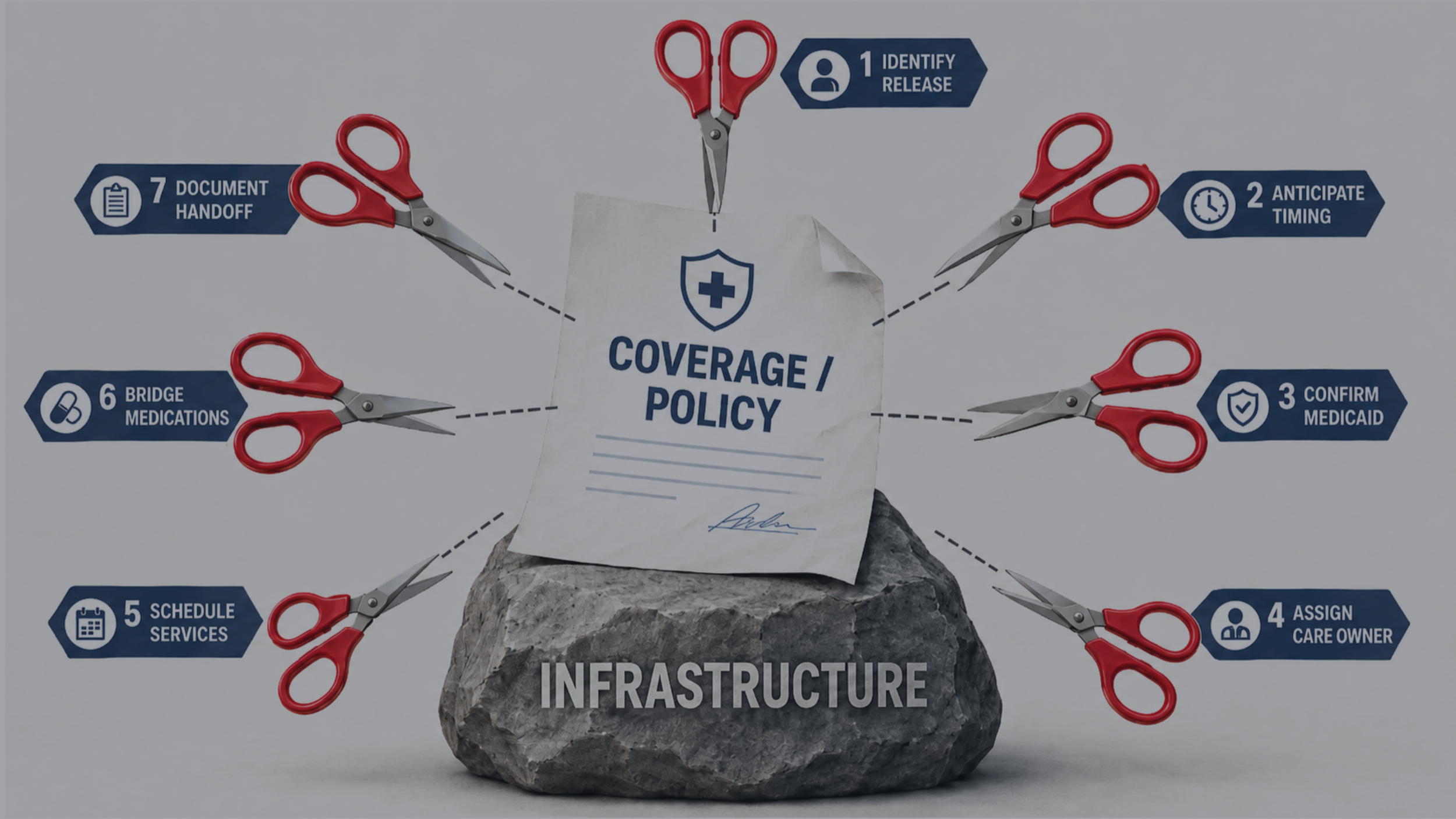
Consider what each step really requires. Identifying the person means matching records across a correctional system and a Medicaid system that were never built to talk to each other. Anticipating release is somewhat straightforward in prisons, which have scheduled release dates, and genuinely hard in jails, where people leave on bail, time served, or a dropped charge, sometimes within hours and rarely on a predictable timeline. Continuity of medication, especially for psychiatric conditions and opioid use disorder, depends on formularies and prescribers lining up across two settings that use different ones. The warm handoff assumes someone on the community side, by role, is expecting this individual on this date. And the billing and data trail has to satisfy a managed care plan, a state agency, and an auditor, all at once. And then there’s HIPAA. A compliance button everyone has to press but no one wants to touch with a 50-foot pole. The conversation begins and ends with “what about HIPAA?” Which is how it stops being a privacy standard and starts being a reason the handoff is someone else's job. I won’t go down that rabbit hole today, though, because what is and is not a HIPAA violation is important and should be part of a state’s plan—and it’s probably more straightforward than you think.
The way I see it, the coverage is the easy part. The workflow is the meat and potatoes of the whole thing. That's why states describe the hardest work not as eligibility policy but as workflow reliability. Health Management Associates, in its lessons-learned analysis of early implementers, points to the same pressure points: matching and identification, care-management structure, data sharing, and community handoffs across dozens of facilities that vary widely in staffing and technical readiness. The waiver is written once. The workflow has to hold thousands of times, in counties with very different capacity.
None of this is an argument for or against the policy. It’s a description of what the policy becomes once it reaches implementation. A coverage change is a decision. A reliable reentry handoff is an operating system, and someone has to build, staff, and maintain it.
The open questions are operational, not ideological. Who owns the handoff when corrections, the health plan, and the community provider all touch it but none fully controls it? How do jails, with their unpredictable release timing, run a process designed around a 90-day pre-release window? What consent and data-sharing structure lets the right information move without stalling the whole thing? States are answering these differently right now, which makes the next two years a live experiment in implementation, watched closely by everyone who will be asked to do it next.
Are you still with me???
What I'd be asking right now
I don't tell you what to support. But if you're the person who has to make this real, these are the questions worth being able to answer. Not because there's a single right answer, but because the gaps tend to surface the moment you try:
Who owns the handoff on the day of release, by role and accountability stream, not by name? (Tie it to a person and the process walks out the door the day they do.)
Can your correctional data and the Medicaid system identify the same person without someone matching records by hand?
When you learn about a jail release with a day's notice, what actually happens next?
Whose job is medication continuity in the gap between release and the first community appointment, and does that person know the release date?
What is the trail that proves the handoff happened, and who can pull it on demand?
If those answers come quickly, you're further along than most. If they don't, that's not a failing. It's just where the work is, and it's worth mapping now, before a rough rollout and the workarounds that harden into permanent practice map it for you.
If you want to see how we can help, let's schedule a chat.
This is one piece from The Strategic Responder, a monthly briefing on state justice, behavioral health, and public systems. Each issue tracks what actually moved and explains how it connects across systems. It does not endorse or oppose policy. Subscribe below to get the full brief, including the month's legislative scan and funding watch.
Sources
Reentry Section 1115 Demonstrations. Medicaid.gov.
Approved and Pending Medicaid Section 1115 Reentry Demonstrations. National Reentry Resource Center.
Changes to Medicaid Will Affect Correctional Facilities and Reentry. National Commission on Correctional Health Care.
Lessons Learned from Implementing 1115 Justice-Involved Reentry Initiatives. Health Management Associates.
